

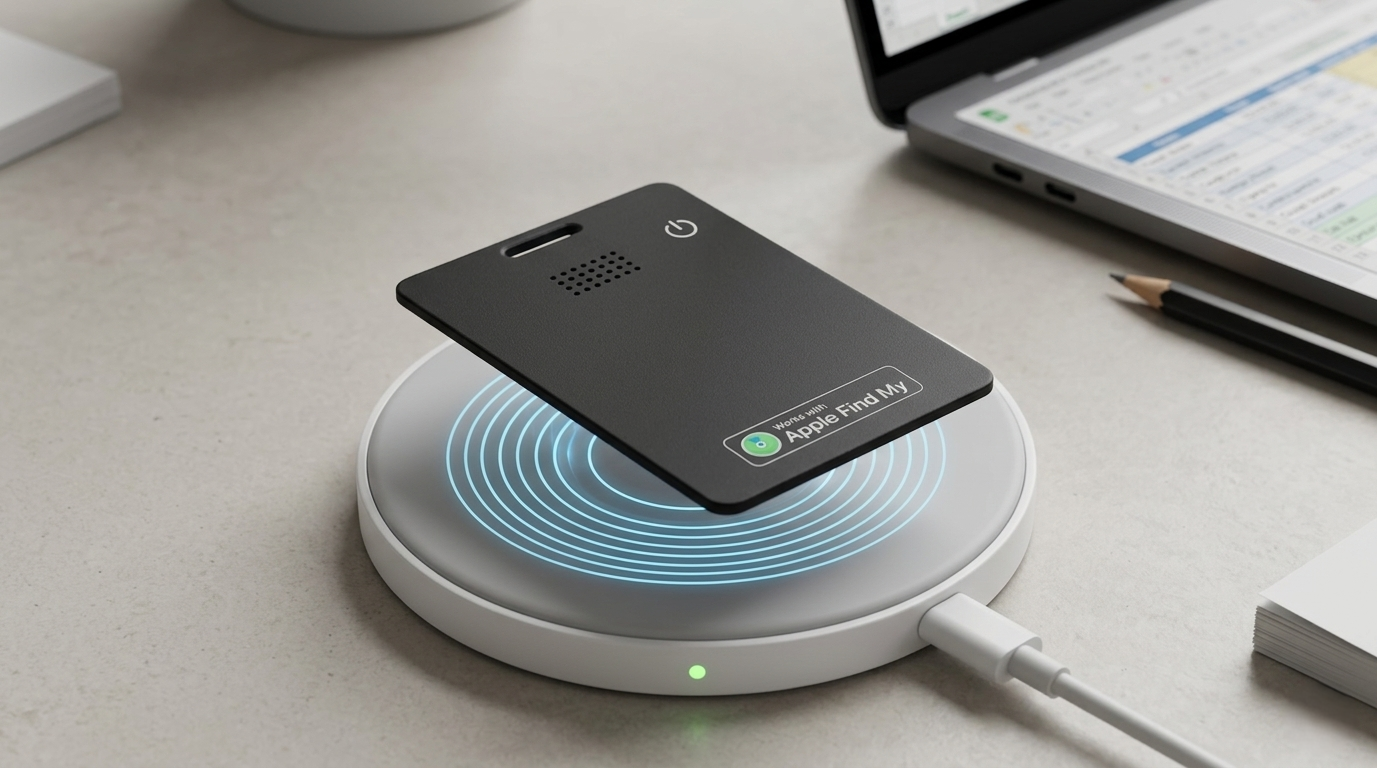
Somewhere between 2023 and now, wireless charging wallet tracker cards quietly went from disposable gadgets with short, two-year batteries to genuinely sophisticated devices equipped with rechargeable lithium cells. The shift happened gradually and without much fanfare, but it completely revolutionized the everyday carry (EDC) ecosystem.
The most obvious question people have when they first discover a wirelessly rechargeable wallet card is a practical one: Does the charging signal actually penetrate thick wallet materials, or does the card need to be pulled out every single time? Furthermore, is this technology as seamless as tech brands claim, or is it just a gimmicky marketing trick that turns out to be frustratingly fiddly in real life?
This comprehensive guide breaks down everything you need to know about how these advanced tracking devices operate, their real-world limitations, and whether they are worth your hard-earned money.
Key Takeaways: Quick Overview
If you are in a hurry, here are the most critical points regarding modern rechargeable card trackers:
- Ecosystem Evolution: Modern cards use miniature internal Qi-receiving coils squeezed into frames as thin as 1.7mm to 2.5mm.
- Wallet Penetration: Charging passes flawlessly through traditional leather, fabric, and canvas, but metal and rigid RFID-blocking shielding will completely block the signal.
- Charging Frequency: Thanks to highly efficient modern chipsets, you only need to place your card on a charger 2 to 3 times per year.
- Card Safety: The low-frequency alternating electromagnetic fields used by standard wireless pads will not demagnetize your credit cards or ruin EMV chips.
How Wireless Charging Works in a Tracker Card
At its core, wireless charging relies entirely on the principles of electromagnetic induction. A standard wireless charging pad contains an internal transmitting coil that generates an alternating magnetic field. When a compatible device is laid on top of the pad, a matching receiving coil inside that device captures the magnetic energy and safely converts it back into an electrical current to juice up the battery.
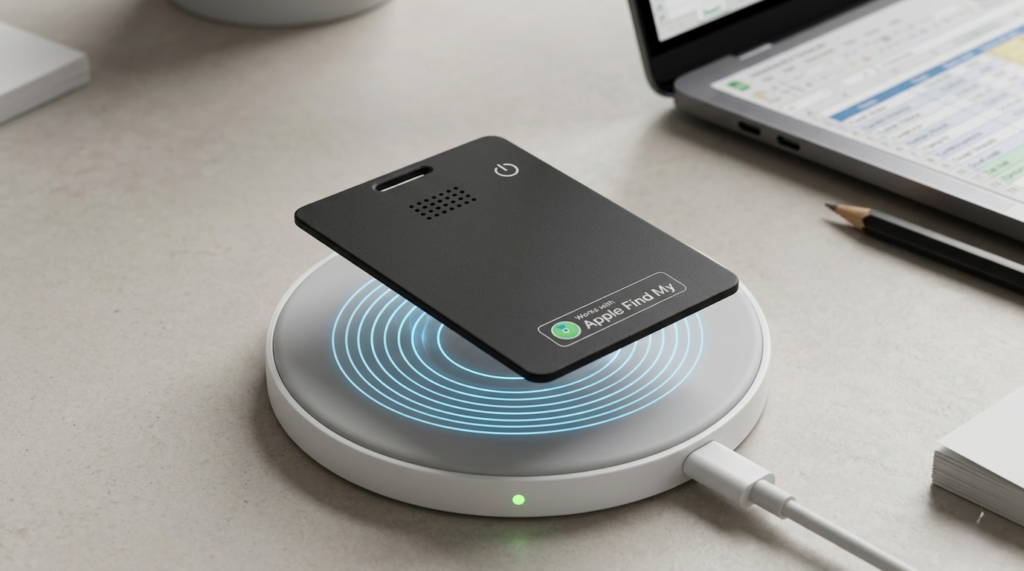
In modern tracking accessories, engineers print or embed an ultra-thin receiving coil directly into the card structure. To put this in perspective, devices like the popular DK01 pack a 155mAh lithium polymer battery and a full Qi-standard wireless receiving coil into a body that is just 1.8mm thick (roughly the thickness of two stacked credit cards).
Because the universal Qi specification allows a power transfer distance of 4mm to 8mm, you do not need millimeter-level precision when placing your wallet on a charging mat. As long as the card is positioned reasonably close to the center of the pad’s primary coil, the magnetic link will initialize successfully.
Does the Card Need to Come Out of the Wallet?
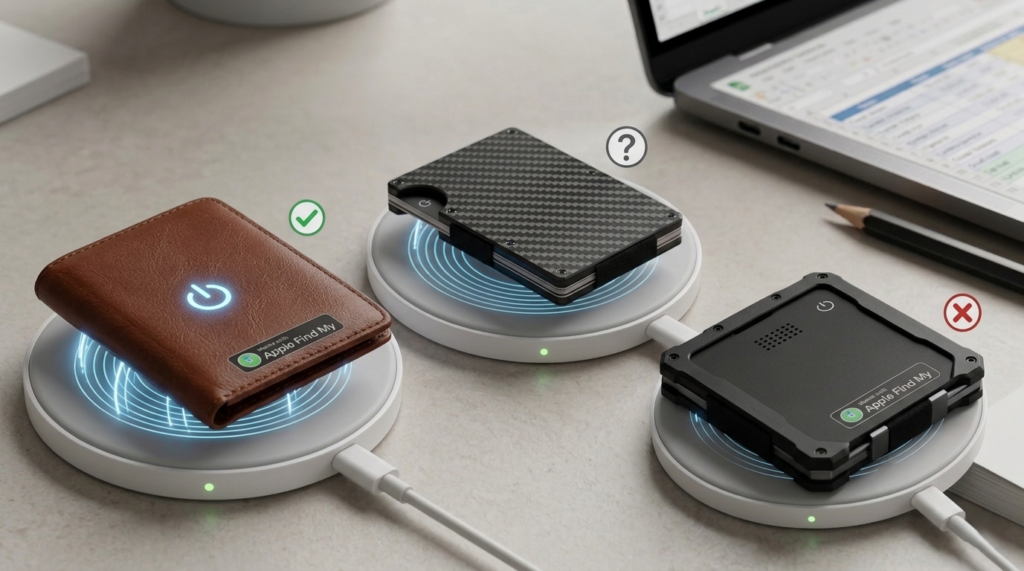
For the vast majority of traditional wallets, no, you do not need to remove the card. However, material composition dictates your actual real-world performance:
| Wallet Material | Can It Charge Through? | Diagnostic Impact |
| Standard Leather | Yes (Flawlessly) | Zero signal loss; charges at normal speeds. |
| Fabric / Canvas | Yes (Flawlessly) | Zero interference. |
| Carbon Fiber | Variable | Standard carbon weaves work fine; conductive metallic threading slows it down. |
| Metal Frames / RFID Shielding | No | Creates a Faraday cage that entirely blocks the magnetic field. |
If you own a minimalist metal wallet or an intense RFID-blocking cardholder, the protective metal layer shields your credit cards by disrupting electromagnetic fields—which unfortunately means it blocks charging waves too. In these instances, you will need to slide the tracker out for a brief top-up. Given that you only have to do this once every 4 to 6 months, spending two minutes to slide a card out is hardly a dealbreaker.
How Long Does It Take to Charge?
Because a typical wireless charging wallet tracker cards setup features a miniature battery (usually between 150mAh to 200mAh) compared to a massive 3,000mAh+ smartphone battery, charging speeds are incredibly fast.
- Average Charge Time: A flat card tops up completely in 1 to 2 hours on a standard Qi wireless mat.
- Hardware Compatibility: You do not need to buy a proprietary adapter. Any charging peripheral you already own—whether it is an Apple MagSafe puck, a bedside multi-device charging station, or a generic desk pad—will transfer power perfectly.
You can simply place your entire wallet on your phone charger overnight; the internal charging circuitry automatically cuts off power once the cell hits 100% to prevent overheating.
Top Qi-Compatible Tracker Cards Available in 2026
The smart tracking market has shifted aggressively toward rechargeable power over the last two years. If you are looking to upgrade your wallet’s security, these are the standout options available right now:
1. The DK01 Smart Card
At an ultra-slim 1.8mm profile, the DK01 is the most cost-effective option for Apple users. It offers a reliable 4 to 6-month battery lifespan per charge and pairs natively with iOS devices.
2. Chipolo CARD (2026 Edition)
The newly refreshed Chipolo CARD features universal Qi-charging integration alongside dual-network cross-compatibility. It can be tracked using both the Apple Find My network and Google’s updated Find My Device platform, boasting an impressive 12-month runtime.
3. KeySmart SmartCard Gen 3
Equipped with a highly efficient next-generation processing chip, the Gen 3 SmartCard boasts an 11-month battery window. The upgraded architecture heavily minimizes accidental drop-offs and improves Bluetooth signal stability.
4. Nomad Tracking Card Air
Measuring an incredibly sleek 1.7mm, the Nomad variant utilizes a unique ultra-thin design profile. While it features excellent build quality and aligns seamlessly via MagSafe arrays, it relies on a slim, specialized charging sleeve rather than open Qi placement.
Real-World Battery Life vs. Manufacturer Claims
While a manufacturer might proudly print “12 Months of Power” on the box, real-world longevity depends heavily on three distinct operational variables:
- Audio Speaker Alerts: Ringing your wallet frequently at high volumes drains the tiny lithium cell rapidly.
- Connection Proximity: If your wallet sits on a desk right next to your phone all day, the constant low-power Bluetooth connection keeps power draw steady.
- Network Pinging: A card left in a luggage bag moving through busy airports will broadcast its location beacons significantly more often, shortening the time between charges.
For realistic planning, assume a baseline of 4 to 6 months of worry-free tracking for budget chipsets, and 8 to 12 months for premium variations under normal, everyday usage patterns.
Does It Damage Your Credit or Debit Cards?
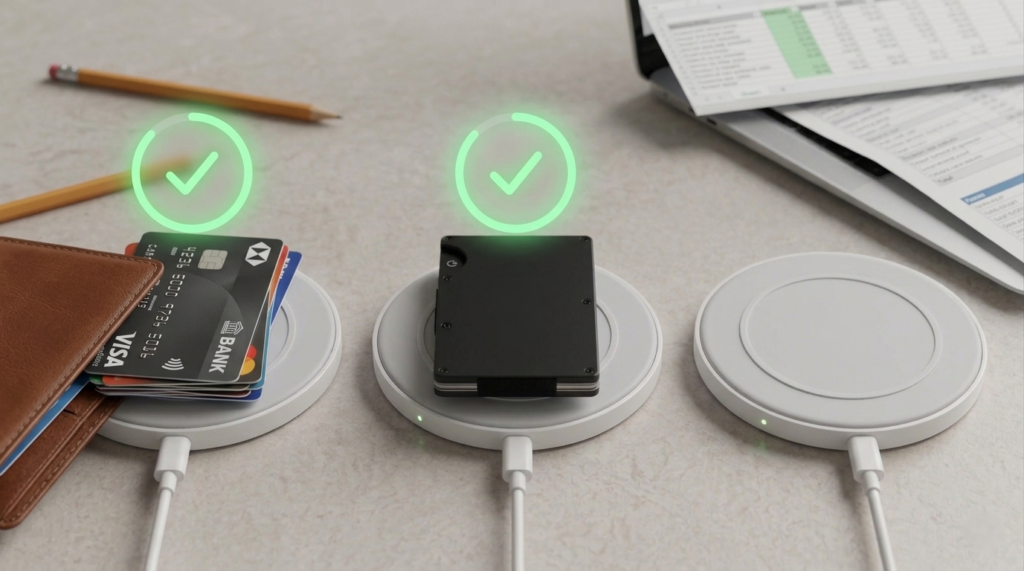
The short answer is no. It is completely safe to leave your bank cards right next to a wireless tracking card while it charges on a pad.
The widespread fear of card corruption stems from a misunderstanding of magnetism. Traditional credit card magnetic stripes are damaged by prolonged exposure to strong, static magnetic forces (like industrial magnets or powerful neodymium clasps).
Wireless Qi chargers emit a low-intensity, alternating electromagnetic frequency that lacks the properties required to alter or wipe the encoded data on a magnetic strip. Furthermore, modern EMV payment microchips and contactless NFC chips are explicitly designed to remain completely unaffected by these standard consumer wireless charging frequencies.
Frequently Asked Questions
Can I charge a wireless tracking card on an Apple MagSafe charger?
Yes. Apple’s MagSafe ecosystem is backward-compatible with standard Qi charging protocols. Placing a Qi-certified tracker card (like the DK01) face-down directly onto a MagSafe disc will charge the card successfully.
How do I verify if my tracker card is fully charged?
Most tracking cards feature a microscopic built-in LED indicator light that illuminates while receiving power and changes color or shuts off when full. Additionally, you can open your smartphone’s native tracking application to view an exact battery percentage readout of the connected accessory.
Can Android phone users use wireless charging tracker cards?
The physical wireless charging technology works identically regardless of your mobile platform. However, the tracking software framework varies. While budget options like the DK01 are restricted exclusively to the iOS framework, premium choices like the updated Chipolo CARD support Google’s network flawlessly.

AG Baloch is an SEO expert, content writer, and technology educator who specializes in creating accurate, user focused content that informs and inspires.