

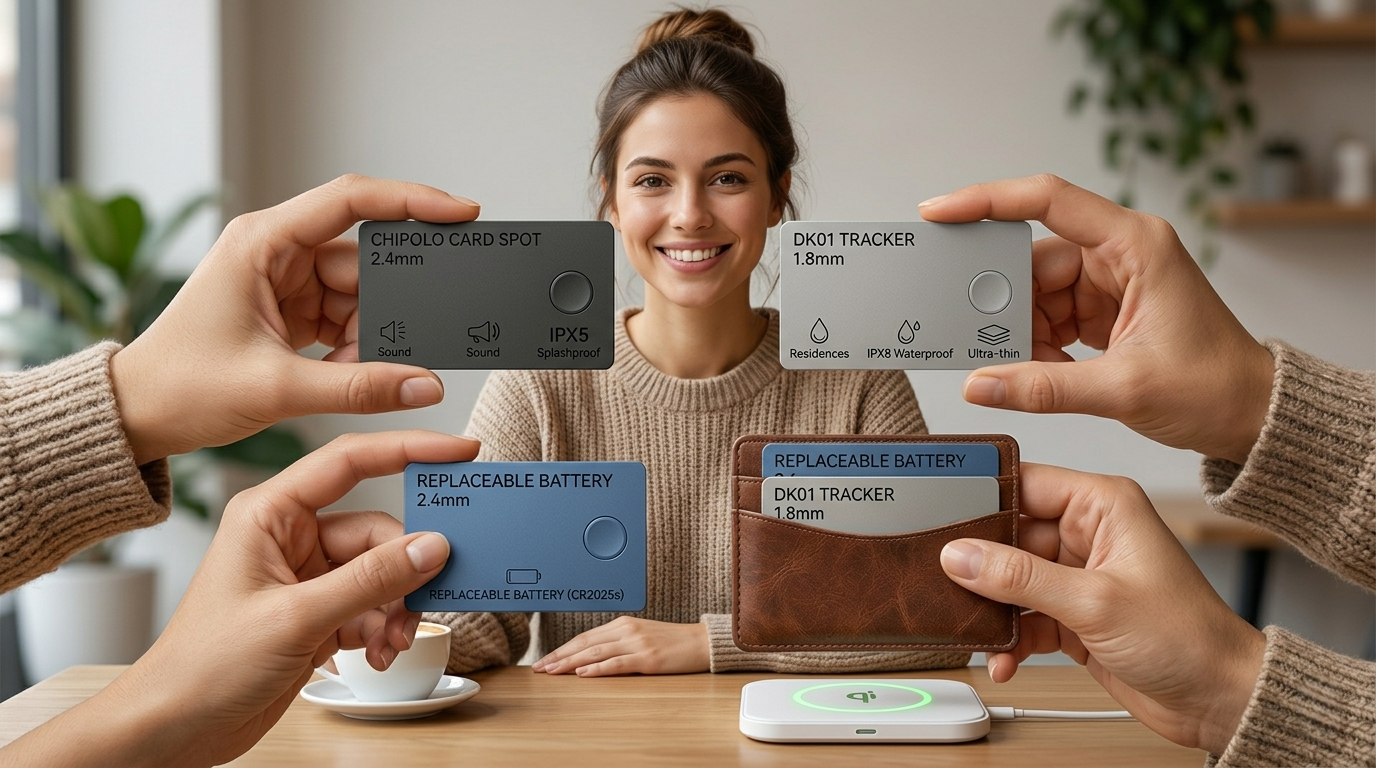
On the surface, the DK01 and the Tile Slim look like they are competing for exactly the same customer. Both are credit card shaped. Both slide into a standard wallet slot. Both promise to help you find a lost wallet through your phone. If you put them side by side on a table, a stranger would struggle to tell them apart.
But spend five minutes with the spec sheets and the picture changes completely. These two trackers are built on entirely different tracking networks, use opposite battery philosophies, and frankly serve different types of people. Picking the wrong one does not just mean getting a slightly inferior product. It can mean buying a tracker that barely works with your phone at all.
Here is an honest comparison of DK01 vs Tile Slim so you can figure out which one actually makes sense for you.
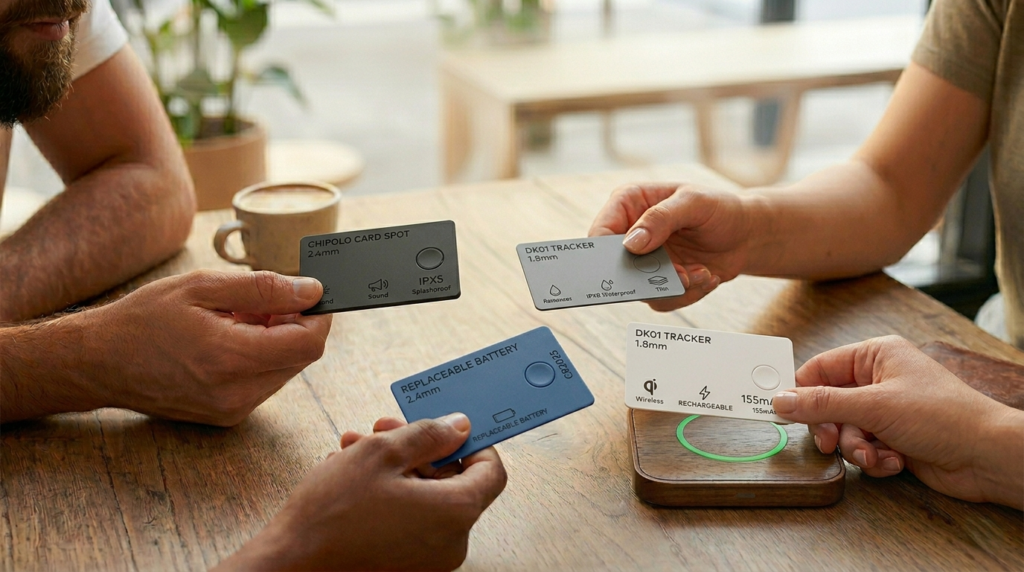
DK01 vs Tile Slim: A Quick Side by Side Look
| Spec | DK01 | Tile Slim |
|---|---|---|
| Thickness | 1.8mm | 2.5mm |
| Dimensions | 85 x 54mm | 86 x 54mm |
| Tracking network | Apple Find My | Google Find Hub (via Life360 app) |
| iPhone compatible | Yes, native Find My | Yes, via Tile app |
| Android compatible | No | Yes |
| Battery | Rechargeable, Qi wireless | Sealed, 3 year life |
| Charging method | Wireless pad | Not rechargeable, full replacement when dead |
| Waterproof rating | IPX8 | IP67 |
| MFi certified | Yes | No |
| Price | $15 to $25 | $35 |
The Network Question This Is the One That Really Matters
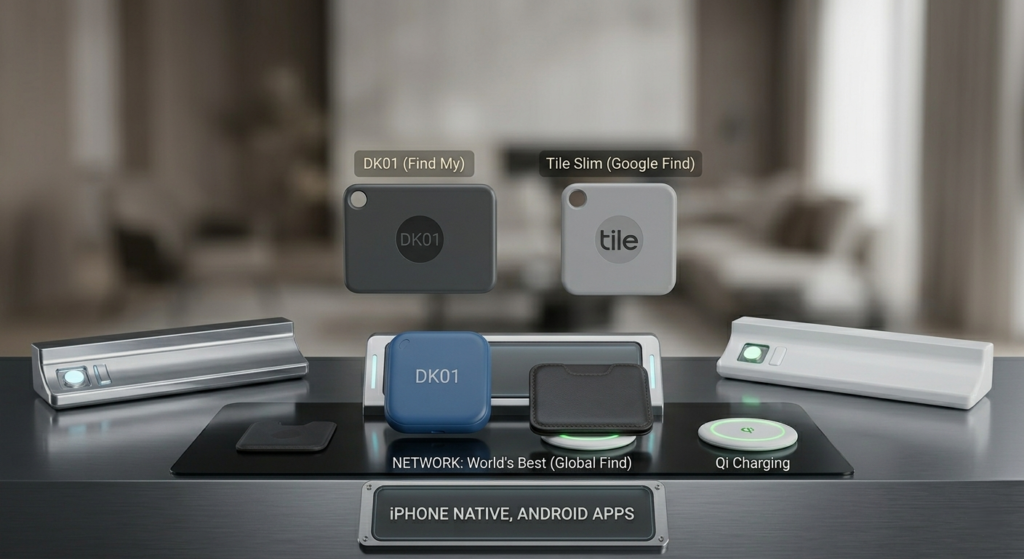
If there is a single thing that should drive your decision between the DK01 and the Tile Slim, it is the tracking network each one uses. Everything else is secondary.
The DK01 uses Apple’s Find My network. This is the same crowd sourced infrastructure that powers AirTag. Every iPhone, iPad, and Mac in the world is a passive relay node in this network. When your wallet goes missing and moves out of Bluetooth range, nearby Apple devices anonymously detect the DK01’s signal and report its location back to you. Apple has over two billion active devices in this network worldwide. In any city, airport, or shopping center on earth, you are surrounded by Find My nodes.
The Tile Slim uses Google Find Hub, accessed through the Life360 app. Tile’s network has grown significantly and now covers over 77 million active nodes. That is a substantial number but it is a fraction of Apple’s coverage. In dense urban environments the gap is manageable. In suburban areas, smaller towns, or less developed regions, Tile’s network thins out and location updates become less frequent and less reliable.
For iPhone users specifically, the DK01’s native Find My integration is also a cleaner experience. You manage it directly inside the Find My app, the same place you see your iPhone, AirPods, and any other Apple accessories. The Tile Slim, even on an iPhone, requires downloading and maintaining the separate Tile app and creating a Life360 account.
For Android users, the situation flips. The DK01 does not work with Android at all. If you use a Samsung, Pixel, or any other Android device, the DK01 is simply not an option. The Tile Slim is purpose-built for cross-platform use and works natively with both Android and iOS through Google Find Hub.
DK01 vs Tile Slim Battery Life: Three Years vs Four Months
This is where opinions tend to diverge most sharply, and it comes down entirely to which inconvenience you find easier to live with.
The Tile Slim has a sealed non-replaceable battery rated for three years. You buy it, pair it, slide it in your wallet, and do not think about it again for three years. There is no charging, no reminders, no pad to put it on. When the three years are up, Tile’s recycling program lets you send the old card back and buy a new one at a discount. For people who genuinely dislike managing device charging, this is a compelling offer.
The DK01 has a rechargeable 155mAh battery that lasts four to six months on a single wireless charge. You charge it on any standard Qi wireless pad, the same one you use for your phone, and get another four to six months of use. Set a reminder on your phone every four months and you will never be caught with a dead tracker.
There are two things worth knowing about the Tile Slim’s battery claim. First, three years is the manufacturer’s rating under standard test conditions. Real-world battery life often falls short of advertised figures, particularly as the battery ages. Second, a dead Tile Slim means buying a completely new card. There is no opening it up, no swapping a coin cell, no charging. Dead means done.
The DK01’s rechargeable approach does require occasional attention. But it also means the card never becomes landfill before its time. From a purely practical standpoint, four to six months per charge is genuinely long enough that most people charge it only two or three times a year.
Thickness and Fit in a Real Wallet
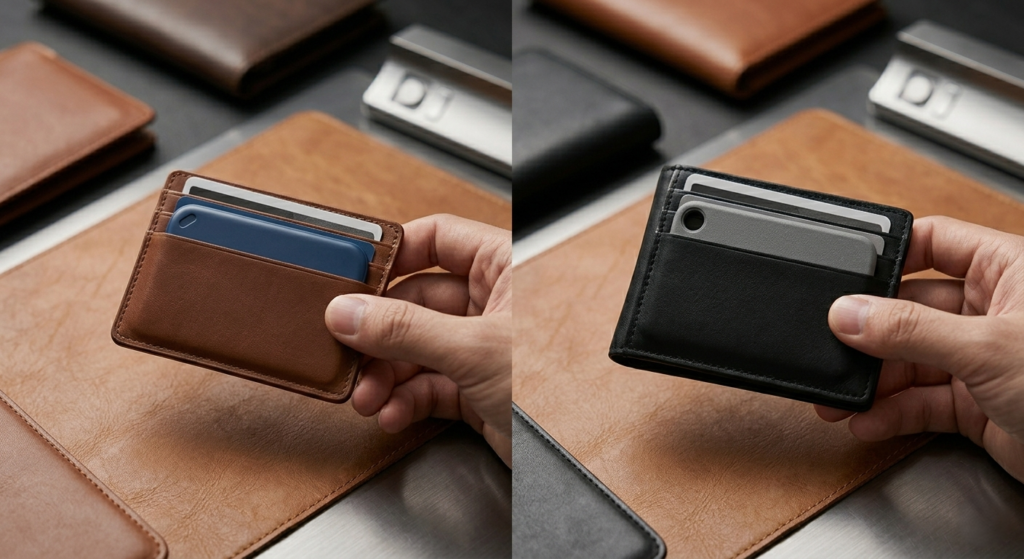
The DK01 is 1.8mm thick. The Tile Slim is 2.5mm thick. That 0.7mm difference is small in absolute terms but noticeable in a slim minimalist wallet.
If you carry a leather bifold with six to eight cards, neither tracker will significantly change how the wallet feels. Both are thin enough to sit comfortably in a card slot. If you carry a slim four card holder or a money clip style wallet, the DK01’s extra slimness does make a subtle but real difference. It sits in the slot more like a regular card and less like a slightly thicker intruder.
The Tile Slim is still genuinely slim by any reasonable standard. It is not uncomfortable to carry. But the DK01 wins on thickness and that is worth knowing if you are particularly fussy about wallet profile.
Waterproofing: Both Are Good, DK01 Is Better
The Tile Slim carries an IP67 waterproof rating. The DK01 has IPX8. As covered in our separate waterproof guide, both ratings offer strong submersion protection for everyday wallet use. IP67 covers one metre of water for 30 minutes. IPX8 goes beyond one metre continuously, with the exact depth and duration specified by the manufacturer.
For a wallet that lives in your pocket, both ratings are more than sufficient. You are not diving with your wallet. The practical difference between IP67 and IPX8 for this use case is minimal. But if you want the higher waterproof certification, the DK01 has it.
Price and Value
The DK01 costs between $15 and $25. The Tile Slim retails at around $35.
For iPhone users comparing the two, the DK01 costs less, is thinner, has better waterproofing, charges wirelessly rather than being thrown away when the battery dies, and uses the larger Apple Find My network. The Tile Slim’s only advantages for an iPhone user are a longer maintenance-free battery period and cross-platform compatibility.
For Android users the calculation is different. The DK01 simply does not work with Android, so comparing prices is irrelevant. The Tile Slim is the right category of product for Android users.
DK01 vs Tile Slim: Who Should Buy Which
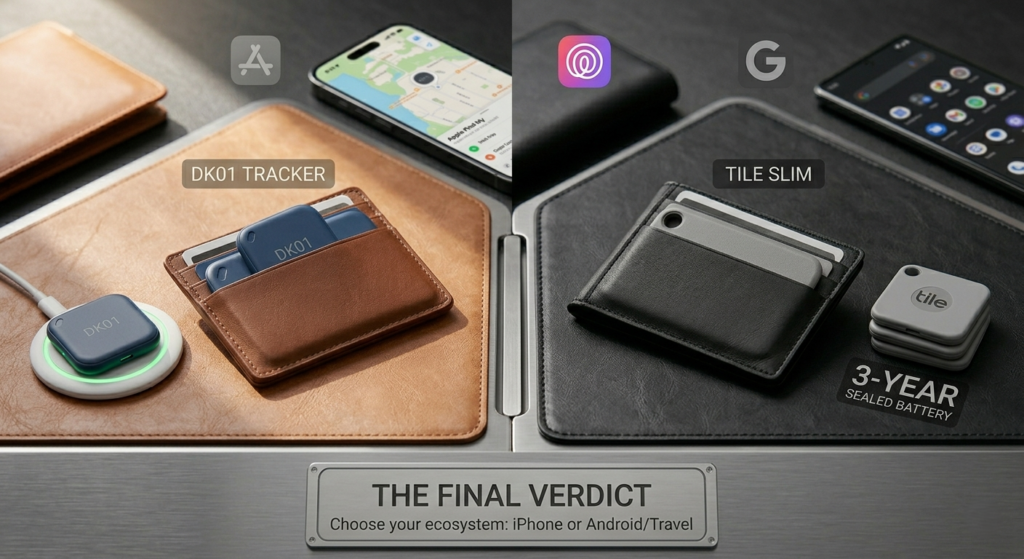
Buy the DK01 if you use an iPhone, want native Find My integration without a separate app, prefer wireless charging over eventual full card replacement, want a thinner card, and value access to Apple’s larger tracking network.
Buy the Tile Slim if you use Android, or if your household has a mix of iPhone and Android users, or if the idea of not thinking about your wallet tracker for three years is genuinely appealing to you regardless of which phone you use.
The one scenario where the Tile Slim makes sense for an iPhone user is this: you travel frequently to places where you may go weeks without access to a wireless charging pad, and you want a tracker you genuinely never have to think about. In that case, the three year sealed battery is a real advantage. For everyone else with an iPhone, the DK01 is the stronger choice.
Frequently Asked Questions
Does the DK01 work with Android phones? No. The DK01 uses Apple’s Find My network and requires an iPhone or other Apple device for setup and tracking. Android users should look at the Tile Slim, Pebblebee Card 5, or similar Google Find Hub-compatible options.
Can an iPhone user use the Tile Slim? Yes, but through the Tile app rather than the native Find My interface. iPhone users who want seamless native integration with Apple’s apps will find the DK01 a cleaner experience. Tile Slim on iPhone works fine as a functional tracker but does not integrate with the Find My app at all.
Is the Tile Slim battery really three years? Tile rates the sealed battery at approximately three years under standard use conditions. Real-world performance varies and tends to fall somewhat short of manufacturer claims as the battery ages, which is common across all battery-powered electronics.
Which has better long-distance tracking coverage? The DK01 uses Apple’s Find My network, which covers over two billion active Apple devices worldwide. Tile Slim uses Google Find Hub with around 77 million active nodes. In most cities and airports both provide useful coverage, but Apple’s network is significantly larger and provides more frequent location updates in most situations.
Can I replace the battery in the Tile Slim? No. The Tile Slim has a sealed non-replaceable battery. When it dies after approximately three years, the card needs to be replaced entirely. Tile offers a recycling program that lets you return the old card and receive a discount on a new one.
Which tracker is better for international travel? The DK01 has an advantage for international travel because Apple’s Find My network is genuinely global. Airports, hotels, and city centers worldwide have dense concentrations of Apple devices. Tile’s network is also present internationally but thinner outside major urban areas, particularly in regions where Android dominates and the Tile app user base is smaller.
Still deciding? Our best wallet tracker cards 2026 guide ranks all the major options in one place. For a deeper look at the DK01, our full DK01 wallet tracker review covers every feature in real-world context. If the battery question is still on your mind, our rechargeable vs battery wallet tracker comparison goes into much more detail on which approach suits different lifestyles.

AG Baloch is an SEO expert, content writer, and technology educator who specializes in creating accurate, user focused content that informs and inspires.