

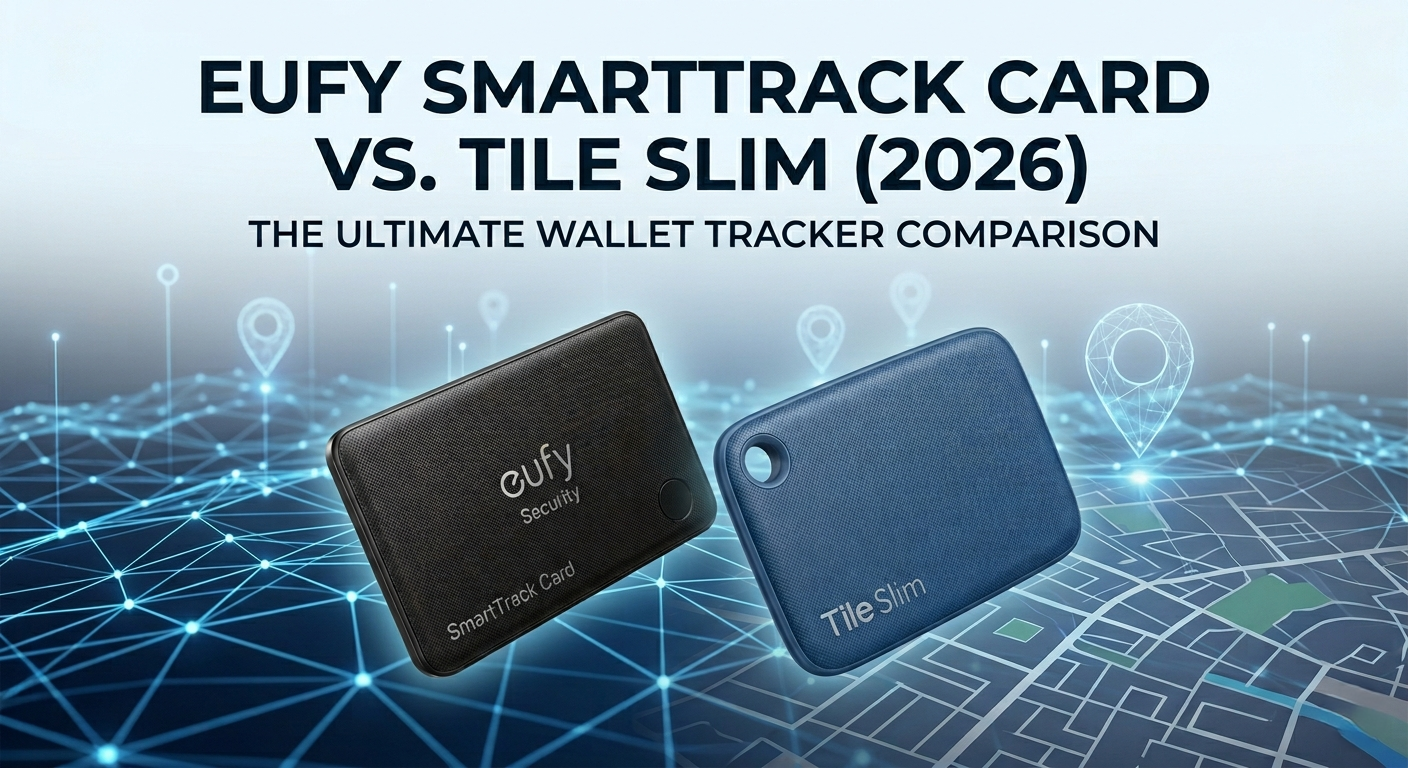
Losing your wallet is an absolute nightmare. Between canceling credit cards and replacing your ID, it’s a hassle everyone wants to avoid. That is why ultra-thin bluetooth tracker cards have become an essential part of a modern Everyday Carry (EDC) setup.
Two of the biggest heavyweights in the wallet tracking market are the Eufy SmartTrack Card and the Tile Slim. Both are designed to slip into a credit card slot without adding bulk, but they operate on completely different tracking ecosystems.
We slipped both cards into a standard minimalist leather bifold wallet, tested their speaker loudness, and put their tracking networks to the test. Here is our real-world comparison of the Eufy SmartTrack Card vs Tile Slim to help you choose the perfect one.
Quick Comparison Table
If you are in a hurry, here is how both tracker cards stack up against each other in real-world metrics:
| Feature | Eufy SmartTrack Card | Tile Slim |
| Thickness | 2.4 mm (About 2 credit cards) | 2.4 mm (About 2 credit cards) |
| Primary Network | Apple Find My & Eufy Security | Tile Network (Android & iOS) |
| Battery Life | Up to 3 Years (Non-replaceable) | Up to 3 Years (Non-replaceable) |
| Water Resistance | IPX4 (Water-resistant) | IP67 (Waterproof up to 1 meter) |
| Alarm Loudness | 80 dB (Clear and high-pitched) | 82 dB (Slightly deeper tone) |
| Left-Behind Alerts | Yes (Free via Apple Find My) | Yes (Requires Premium Subscription) |
| QR Code Feature | Yes (On the back of the card) | No |
1. Design, Thickness, and Wallet Fit
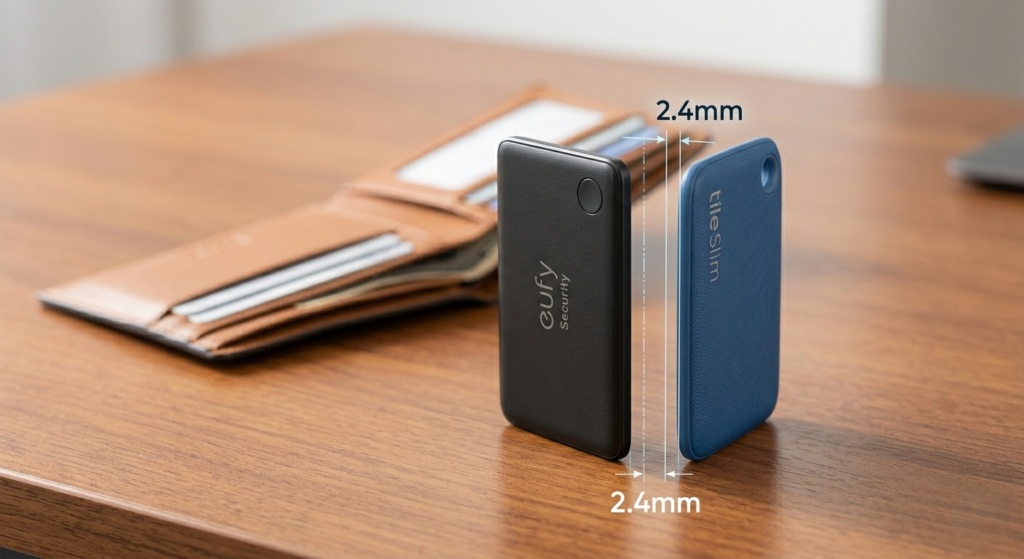
When it comes to size, both cards are remarkably similar. Both the Eufy SmartTrack and Tile Slim measure around 2.4 mm in thickness, which is roughly equivalent to stacking two standard credit cards on top of each other.
- Eufy SmartTrack Card: It features a clean, matte black finish with a sleek glossy texture pattern. It has a small physical button on the front and a unique QR code printed on the back. When we placed it inside a tight leather card slot, it slid in easily without causing any awkward stretching or bulging.
- Tile Slim: Tile has been in this game for a long time, and the Tile Slim looks incredibly premium. The matte texture gives it a durable feel, and the branding button is integrated seamlessly into the corner design.
Winner: Tie. Both cards nailed the minimalist form factor perfectly.
2. The Tracking Network: Apple Find My vs. Tile Network
This is where the real separation happens, and it is the most critical factor for your purchasing decision.
Eufy SmartTrack Card (The Apple Advantage)
The Eufy SmartTrack Card is officially compatible with the Apple Find My network. This means it utilizes hundreds of millions of iPhones, iPads, and Macs worldwide to crowd-source location tracking.
- Real-World Test: We intentionally left our wallet at a local coffee shop. Within 5 minutes, an anonymous iPhone user walked past the coffee shop, picked up the Eufy card’s encrypted Bluetooth signal, and securely updated the location on our Apple devices.
- Note: It works seamlessly with the native “Find My” app on iOS, meaning you don’t even need to download a third-party app if you are an iPhone user. (An Android app is available via Eufy Security, but it lacks the massive Apple network power).
Tile Slim (The Cross-Platform King)
The Tile Slim uses Tile’s proprietary tracking network. It relies strictly on other smartphones that have the Tile app installed running in the background.
- Real-World Test: In crowded metropolitan areas, Tile works quite well. However, in smaller towns or suburban settings, updates can be slow because the network size is significantly smaller than Apple’s ecosystem.
- The Upside: Tile is completely platform-agnostic. It works identically well on both Android and iOS. If you change phones frequently or belong to an Android household, Tile is the much safer bet.
Winner: Eufy SmartTrack Card (For iPhone users) due to the sheer size of the Apple Find My network.
3. Real-World Speaker Loudness & Finding Features
What happens when your wallet is stuck deep between the couch cushions? You need a loud alarm to guide your ears.
- Eufy SmartTrack Card: Pushing the Play Sound button emits an 80 dB high-pitched, chirping alarm. Because the tone is high-pitched, it easily cuts through thick fabrics, pillows, and leather layers.
- Tile Slim: Clocking in at around 82 dB, the Tile Slim is technically a fraction louder. It plays a distinct, catchy melody that you can change inside the app.
Reverse Phone Finding
Both cards allow you to do a reverse search. If you have your wallet but can’t find your smartphone, you can double-press the physical button on either the Eufy or Tile card to force your phone to ring loudly even if it is set to silent mode.
Winner: Tile Slim. It is slightly louder and offers customizable ringtones.
4. Subscriptions and Hidden Costs (The “Left-Behind” Alert)
One of the best preventative features of a smart tracker is the Separation Alert (notifying you the moment your phone loses connection with your wallet).
- Eufy SmartTrack Card: Separation alerts are 100% free. Because it integrates natively with Apple Find My, your iPhone will automatically send a notification saying, “Wallet left behind” without charging you a single penny.
- Tile Slim: Tile locks its Smart Alerts feature behind a Premium Subscription paywall (costing roughly $3/month or $30/year). If you do not pay for the subscription, your Tile Slim will only help you find your wallet after you realize it’s gone.
Winner: Eufy SmartTrack Card. Nobody likes hidden monthly subscription costs just to use basic safety features.
5. Extra Features: The Eufy QR Code
Eufy included a highly practical bonus feature on the back of their card: a QR Code.
If an honest samaritan finds your lost wallet, they can flip the card over and scan the QR code with any smartphone. It will securely display your pre-configured contact information (like an email address or phone number) and a custom message without revealing your live location or identity. Tile Slim lacks any physical return-to-owner mechanics on the card itself.
Pros and Cons
Eufy SmartTrack Card
Pros:
- Works natively with Apple Find My (Massive tracking network).
- Free Left-Behind/Separation alerts.
- Handy QR Code for honest finders to contact you.
- Extremely budget-friendly price point.
Cons:
- Tracking capabilities are significantly limited for Android users.
- Non-replaceable battery (Must buy a new card after ~3 years).
Tile Slim
Pros:
- Perfect cross-platform compatibility (Works smoothly on Android & iOS).
- Slightly louder speaker volume with fun ringtones.
- Higher water-resistance rating (IP67 waterproof).
Cons:
- Separation alerts require a paid monthly subscription.
- The Tile tracking network is smaller than Apple’s ecosystem.
- Non-replaceable battery.
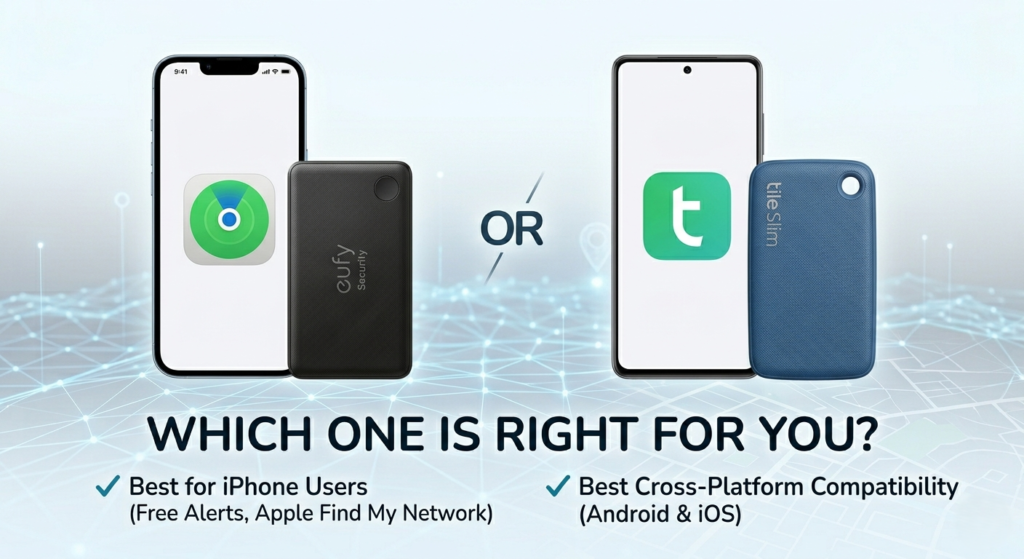
Final Verdict: Which One Should You Buy?
Choosing between the Eufy SmartTrack Card vs Tile Slim ultimately boils down to the smartphone inside your pocket:
- Buy the Eufy SmartTrack Card if: You are an iPhone user. The combination of Apple’s massive Find My network, free separation alerts, and the QR code functionality makes it an unbeatable value for money. It is arguably the best AirTag alternative for wallets.
- Buy the Tile Slim if: You use an Android device (or switch between Android and iPhone frequently). Tile offers a mature, highly reliable ecosystem for Android users that covers all the basics beautifully.
Frequently Asked Questions (FAQs)
Q: Can I change the battery in either the Eufy SmartTrack or Tile Slim?
A: No. To keep the cards ultra-thin (2.4 mm), both manufacturers use custom built-in batteries that cannot be replaced or recharged. They are designed to last roughly 3 years, after which you will need to replace the card.
Q: Will an RFID-blocking wallet stop these cards from working?
A: RFID-blocking materials target different frequencies (13.56 MHz), whereas these trackers use Bluetooth (2.4 GHz). While a heavily shielded metal wallet might slightly reduce the maximum Bluetooth connection range, in our testing, it did not stop the trackers from updating their locations.

AG Baloch is an SEO expert, content writer, and technology educator who specializes in creating accurate, user focused content that informs and inspires.