

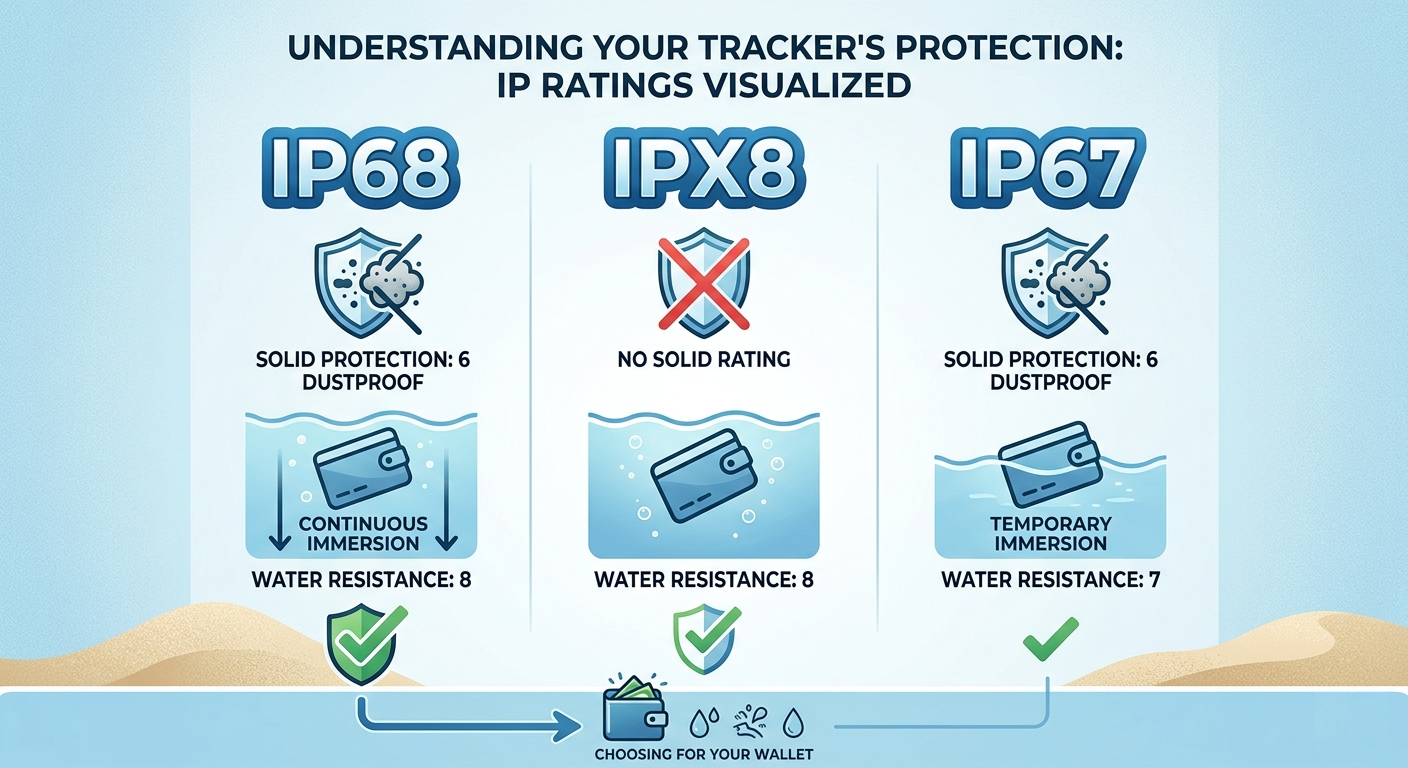
You are shopping for a wallet tracker card. One says IP68. Another says IPX8. A third claims IP67. All three say “waterproof.” All three show pictures of the card underwater. Here is the comparison of IP68 vs IPX8 Waterproof Rating What It Means for Your Tracker
Which one is actually better protected? Are they the same thing? Does the difference even matter for a device that lives inside your wallet?
These are fair questions and the answers matter more than most product pages will tell you. This guide explains the IP rating system in plain language, breaks down the real difference between IP68 and IPX8, and tells you exactly what each rating means for a wallet tracker card you will carry every day.
What Is an IP Rating?
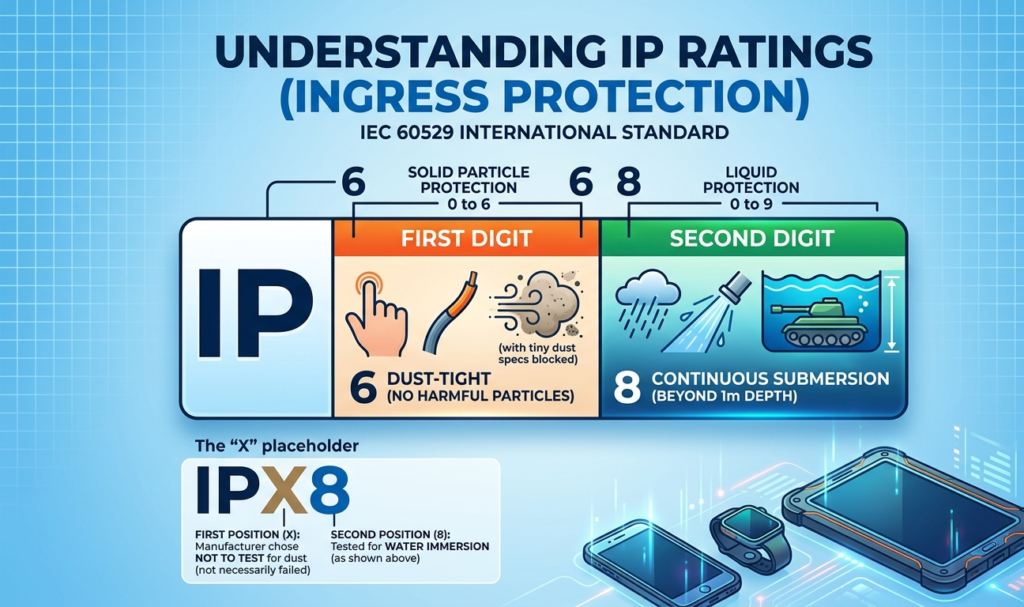
IP stands for Ingress Protection. It is an international standard defined by the IEC 60529 specification that classifies how well a device’s casing resists the entry of solid particles and liquids.
Every IP rating consists of two digits after the letters “IP”:
First digit Solid particle protection (0 to 6) This measures resistance to dust, dirt, sand, and other solid particles. A rating of 6 means the device is completely dust-tight — no harmful particles can enter under any conditions.
Second digit Liquid protection (0 to 9) This measures resistance to water and other liquids. A rating of 8 means the device can withstand continuous submersion in water beyond one metre depth.
The “X” placeholder Sometimes one digit is replaced by the letter X. This does not mean the device failed that test it means the manufacturer chose not to test for that category. IPX8, for example, means the device was tested for water immersion (rating 8) but was not submitted for dust testing (X in the first position).
IP68 vs IPX8 Waterproof Rating Difference
Here is the comparison most product pages skip:
| Rating | Dust Protection | Water Protection |
|---|---|---|
| IP68 | 6 — Completely dust-tight | 8 — Submersion beyond 1 metre |
| IPX8 | X — Not tested for dust | 8 — Submersion beyond 1 metre |
| IP67 | 6 — Completely dust-tight | 7 — Submersion at 1 metre for 30 min |
| IPX5 | X — Not tested for dust | 5 — Protected against water jets |
The key difference between IP68 and IPX8 is that IP68 protects against both dust and water, while IPX8 focuses on water resistance only and carries no dust rating.
Both IP68 and IPX8 share the same water protection level the “8” digit means the device is rated for continuous submersion deeper than one metre. The exact depth and duration is defined by the manufacturer. A common standard is 1.5 metres for 30 minutes, but some manufacturers specify deeper or longer.
In plain terms: for water protection, IP68 and IPX8 are equivalent. The only practical difference is that IP68 also guarantees complete dust protection, while IPX8 does not address dust at all.
What Each Rating Digit Actually Means
First Digit — Solid Protection
| Rating | Protection Level |
|---|---|
| 0 | No protection |
| 1 | Objects larger than 50mm |
| 2 | Objects larger than 12.5mm |
| 3 | Objects larger than 2.5mm |
| 4 | Objects larger than 1mm |
| 5 | Dust protected — limited ingress, no harmful deposits |
| 6 | Dust-tight — complete protection, no ingress at all |
| X | Not tested |
Second Digit Liquid Protection
| Rating | Protection Level |
|---|---|
| 0 | No protection |
| 1 | Vertically dripping water |
| 2 | Dripping water up to 15° tilt |
| 3 | Spraying water up to 60° |
| 4 | Splashing water from any direction |
| 5 | Low-pressure water jets from any direction |
| 6 | High-pressure water jets from any direction |
| 7 | Temporary submersion up to 1 metre for 30 minutes |
| 8 | Continuous submersion beyond 1 metre — depth and time defined by manufacturer |
What Does This Mean for a Wallet Tracker Card?
Now that you understand the ratings, here is what they actually mean for a device that lives inside your wallet.
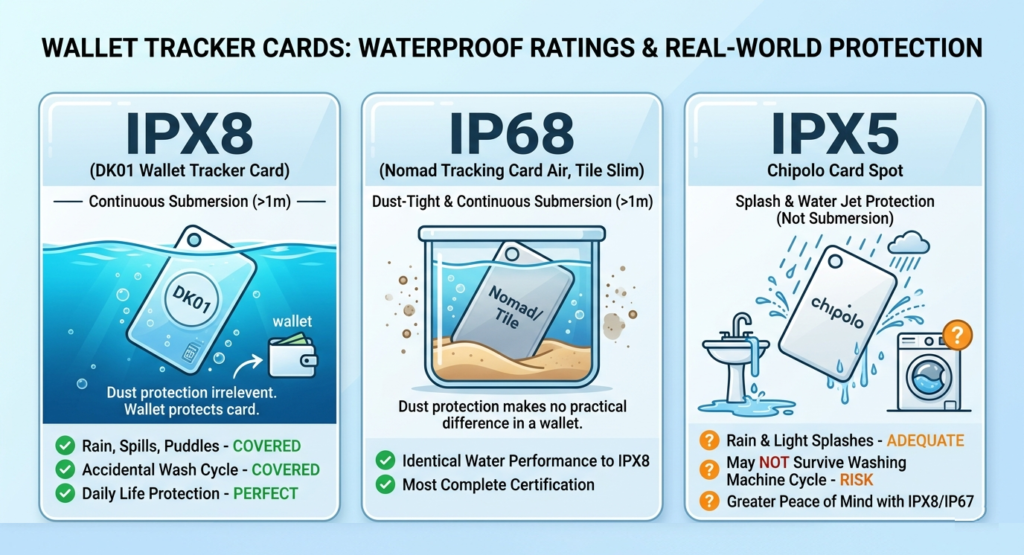
IPX8 (DK01 Wallet Tracker Card)
The DK01 carries an IPX8 rating. In practical terms this means it has been tested for continuous submersion in water beyond one metre depth. It was not submitted for dust testing but for a device inside a wallet, dust resistance is essentially irrelevant. Your wallet protects the card from dust exposure far more effectively than any IP rating could.
IPX8 for a wallet tracker means: rain, spills, puddles, and accidental washing machine cycles all covered. This is exactly the kind of protection a wallet tracker needs in daily life.
IP68 (Nomad Tracking Card Air, Tile Slim)
IP68 adds complete dust-tight certification on top of the same IPX8-level water protection. For a wallet tracker, the dust protection element makes no practical difference your wallet is not exposing the card to sandy or dusty environments.
Both IPX8 and IP68 trackers will perform identically in the situations that actually matter for wallet carry: rain, spills, and submersion.
IPX5 (Chipolo Card Spot)
IPX5 is a significantly lower standard. It covers splash and water jet protection rain, light splashes, and moderate water exposure. It does not cover submersion. If your wallet ends up fully submerged dropped in a sink, left in a pocket through a wash cycle an IPX5 card may not survive intact.
For everyday use in normal conditions, IPX5 is adequate. For greater peace of mind, IP67 or IPX8 is the safer choice.
What IP Ratings Do Not Cover
This is a critical point that most product marketing skips entirely.
IP ratings are tested under controlled laboratory conditions using clean, fresh, static water. The rating does not guarantee protection against:
Saltwater Ocean water is corrosive and can damage seals and electronics that would survive fresh water submersion.
Chlorinated pool water The chemicals in pool water can degrade the rubber gaskets that create the waterproof seal over time.
Coffee, juice, or other liquids IP ratings are tested with fresh water only. Other liquids are not covered by the rating.
Pressurized water IP7 and IP8 tests use still, static water. A device might survive being submerged but fail if hit with a direct, high-pressure blast.
Repeated submersion over time Waterproof seals degrade with use. A device rated IPX8 when new may offer less protection after two years of daily use, especially if it has been dropped or physically stressed.
For a wallet tracker card, none of these limitations are likely to matter in everyday use. Your wallet is not going into the ocean or a swimming pool. But it is useful to understand that IP ratings describe controlled test conditions, not an absolute guarantee of waterproof performance in every situation.
IP Rating Comparison: All Wallet Tracker Cards
| Tracker Card | IP Rating | Dust Protected | Water Protected | Submersion |
|---|---|---|---|---|
| DK01 | IPX8 | Not tested | Yes | Beyond 1m |
| Nomad Tracking Card Air | IP67 | Yes (dust-tight) | Yes | 1m / 30 min |
| Tile Slim | IP67 | Yes (dust-tight) | Yes | 1m / 30 min |
| Chipolo Card Spot | IPX5 | Not tested | Splash only | Not rated |
| Pebblebee Card 5 | IP66 | Yes (dust-tight) | Yes | Jet resistant |
| eufy SmartTrack Card E30 | IP67 | Yes (dust-tight) | Yes | 1m / 30 min |
For daily wallet carry, IPX8 and IP67 provide equivalent real-world protection. Both will survive everything a wallet is likely to encounter rain, spills, and the occasional washing machine accident.
Which Rating Should You Choose for a Wallet Tracker?
Minimum acceptable: IP67 or IPX8
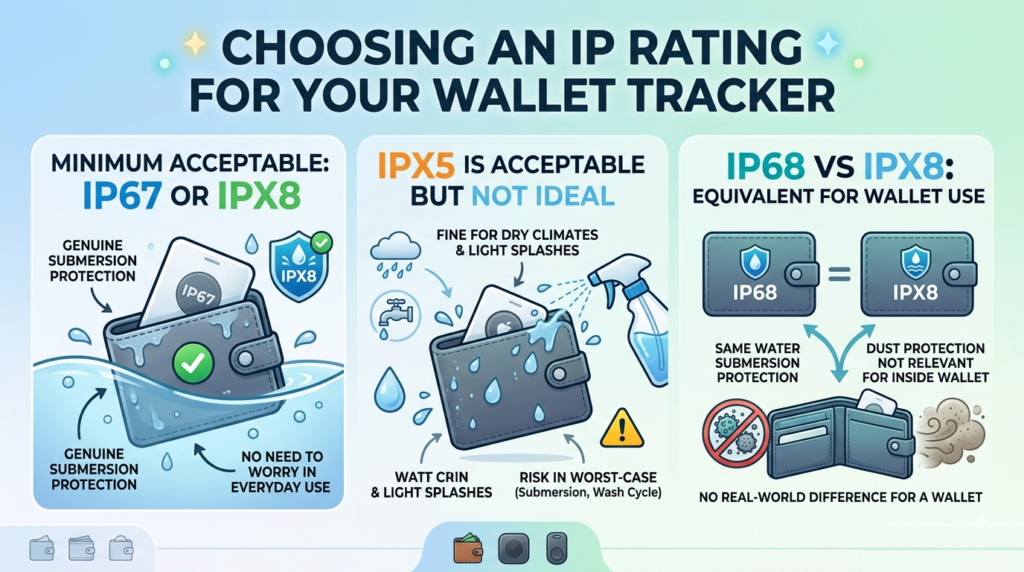
Both provide genuine submersion protection. If your wallet tracker carries either of these ratings, you have nothing to worry about in everyday use.
IPX5 is acceptable but not ideal
If you live in a dry climate and your wallet never gets genuinely wet, IPX5 will serve you fine. But for the peace of mind that your tracker survives a worst-case scenario pocket left in the rain, bag dropped in a puddle, wallet going through a wash IPX7, IPX8, or IP67 is worth the small premium.
IP68 vs IPX8 for a wallet tracker they are equivalent
For the specific use case of a wallet tracker card, there is no practical difference between IP68 and IPX8. Dust protection is not a relevant factor for a card inside a wallet. Both ratings offer the same water submersion protection.
If two otherwise identical tracker cards are priced the same and one is IP68 while the other is IPX8, the IP68 card offers marginally more comprehensive certification. But in real-world wallet use, you will never notice the difference.
Frequently Asked Questions
Is IPX8 better than IP67? For water protection, IPX8 is generally better than IP67. IP67 is rated for one metre of submersion for 30 minutes. IPX8 is rated for submersion beyond one metre the exact depth and duration is defined by the manufacturer and is typically more demanding than IP67. However, IP67 also includes dust-tight certification (the “6” digit), which IPX8 does not address.
Is IP68 the highest waterproof rating? IP68 is the highest common consumer waterproof rating for submersion. There is also IP69K, which protects against high-pressure, high-temperature steam jets used in industrial and food-processing equipment. For consumer electronics including wallet tracker cards, IP68 or IPX8 is the highest rating you will encounter.
Does IPX8 mean completely waterproof? IPX8 means the device was tested for continuous submersion in water beyond one metre depth under controlled laboratory conditions using fresh, still water. It does not guarantee protection against saltwater, pool chemicals, or high-pressure water jets. For everyday wallet use, IPX8 provides excellent protection for all realistic scenarios.
Can I wash my wallet tracker card? If it carries IPX8 or IP67/IP68 rating, it will survive being in a washing machine cycle. However, the detergents and agitation in a washing machine are not what IP ratings test for. Most IPX8 and IP68 tracker cards will survive a wash cycle, but this is not something manufacturers explicitly guarantee.
Why does the DK01 have IPX8 instead of IP68? The “X” in IPX8 simply means the manufacturer did not submit the device for dust ingress testing not that it failed. For a wallet tracker card that lives inside a wallet, dust protection testing is not a relevant concern. The water protection level of the DK01’s IPX8 rating is equivalent to or exceeds IP68 water protection in most testing scenarios.
What is the waterproof rating of the Chipolo Card Spot? The Chipolo Card Spot carries an IPX5 rating, which covers splash and water jet resistance but does not cover submersion. For most everyday use this is adequate, but it offers less protection than IPX8 or IP67-rated alternatives.
Now that you understand waterproof ratings, see how the DK01’s IPX8 protection holds up in our full DK01 wallet tracker card review. Comparing all your options? Our best wallet tracker cards 2026 guide covers every major card with full specs. Not sure what else to look for before buying? Our wallet tracker card buying guide covers all seven specs that actually matter.

AG Baloch is an SEO expert, content writer, and technology educator who specializes in creating accurate, user focused content that informs and inspires.